Lab History
Since 1964, the LDEO Paleomagnetics Lab has been an exciting place, central to development of the study of the paleomagnetism of deep sea sediments, development of the geomagnetic polarity timescale, and much more. That story is best told by the people that have been part of that history.
Accounts:
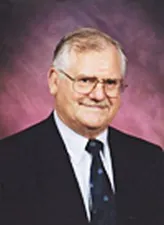
When I finally got to Lamont, it was because of Ted Irving talking to Jack Oliver on a bus at the IUGG meeting in San Francisco. Jack Oliver was asking..."We'd like to get someone at Lamont to do paleomagnetism" and Ted said, "Well, you should, Opdyke's the guy you need." And Doc Ewing had--I've got to give him his due...--wanted somebody to do paleomagnetism on marine cores and said we wanted to correlate on doing that. Why he should think that was possible, I have no bloody idea...
[Lamont] was a very, very dynamic place, and filled with very dynamic people...My only problem was that I had differing scientific views to almost everybody at Lamont, so I got into a lot of arguments with people.
I was in the magnetics department working for Jim [Heirtzler], and my first graduate student, John Foster came...One of the things I was hired to do was to look at the magnetic stratigraphy in cores. And I had known, the first time I had come across magnetic stratigraphy in cores with Chris Harrison, who is now at the University of Miami...had started to do this for his Ph.D. thesis...Chris was having a hard time because he was working with very short cores, gravity cores...I was a bit wary of the business of magnetic stratigraphy in cores--I didn't know it would work, and I didn't know where the magnetite would come from, and all sorts of things.
Wally Broecker brought back some cores from the Pacific on the Vema 21 cruise, and they were unfortunately in the red clay area, and but...he had internally oriented them so that they were, you know, had a mark down the center of the core so that they were not disoriented from section to section, because it was an equatorial core. So I put John Foster to work...and he got reversals of magnetization in these low sedimentation rate cores, but were not 180 degrees; they were about 150 or 140 degrees. So we had reversals, but the weren't exactly nice and crisp and clean...[John] was running around talking to everybody in the observatory about this...
...Foster was talking to Billy Glass, and Glass said, "Well, why don't you look at the Antarctic cores where you don't have a problem," that Jim Hays has just finished doing his thesis on. Because we know that Hays has shown that there was a long time involved, and they were Pleistocene. And so also they have very steep inclinations, so you don't have to worry about orientation. And so they actually got together and they did this, they ran the first core, and they presented to me, and I said, “Wow, that’s good. Cool.” So we started to work then, and I talked to Jim Hays and I talked to Bruce Heezen, and Bruce said, “Well, we’ll put Billy Glass on this to do it for his thesis, these cores from the Antarctic.” And also there was a post doc working for him, Dragon von Ninkovich, who was also interested in correlating volcanic ash beds. So he was doing this in the North Pacific, so we started to run those as well, and Dragon was running them and so was Billy Glass and they were...the first papers on the magnetic stratigraphy of cores...
...We had this big breakthrough...I gave the first paper in he spring of 1965 or 1966...AGU meeting...We had scheduled to give a paper on the White Mountain series and...I used the slot and then just gave the paper on the cores. And this was sort of sensational. It came right with Walter Pitman's first presentation of Eltanin 19 profile. It was given at the same meeting, so we were sort of off and running then. We blew the socks off people, you know. [Allan V.] Cox and [Richard] Doel were there, and Brent Dalrymple I think...We had all this great data and it was just bright future, you could see all sorts of things to do...
Excerpts from:
Interview of Neil Opdyke by Ronald Doel on 1997 March 17, Niels Bohr Library & Archives, American Institute of Physics, College Park, MD USA, www.aip.org/history-programs/niels-bohr-library/oral-histories/22907-1
and
Interview of Neil Opdyke by Ronald Doel on 1997 July 11, Niels Bohr Library & Archives, American Institute of Physics, College Park, MD USA, www.aip.org/history-programs/niels-bohr-library/oral-histories/22907-2
In September 1965, I moved from Cambridge, England, where I had just completed my Ph.D., to Princeton. There I took up an appointment as an 'instructor' in the Department of Geology, Harry Hess's department. Within nine months of my arrival in Princeton, I made two visits to Lamont: one in February 1966, I think at the invitation of Neil Opdyke, and the other in May of June 1966, to give a talk...
When I arrived, Neil was working on a diagram on a light table. It transpired that it was the diagram that would become figure 1 of the paper on the paleomagnetism of Antarctic deep-sea sediment cores, that was published in Science later that year.
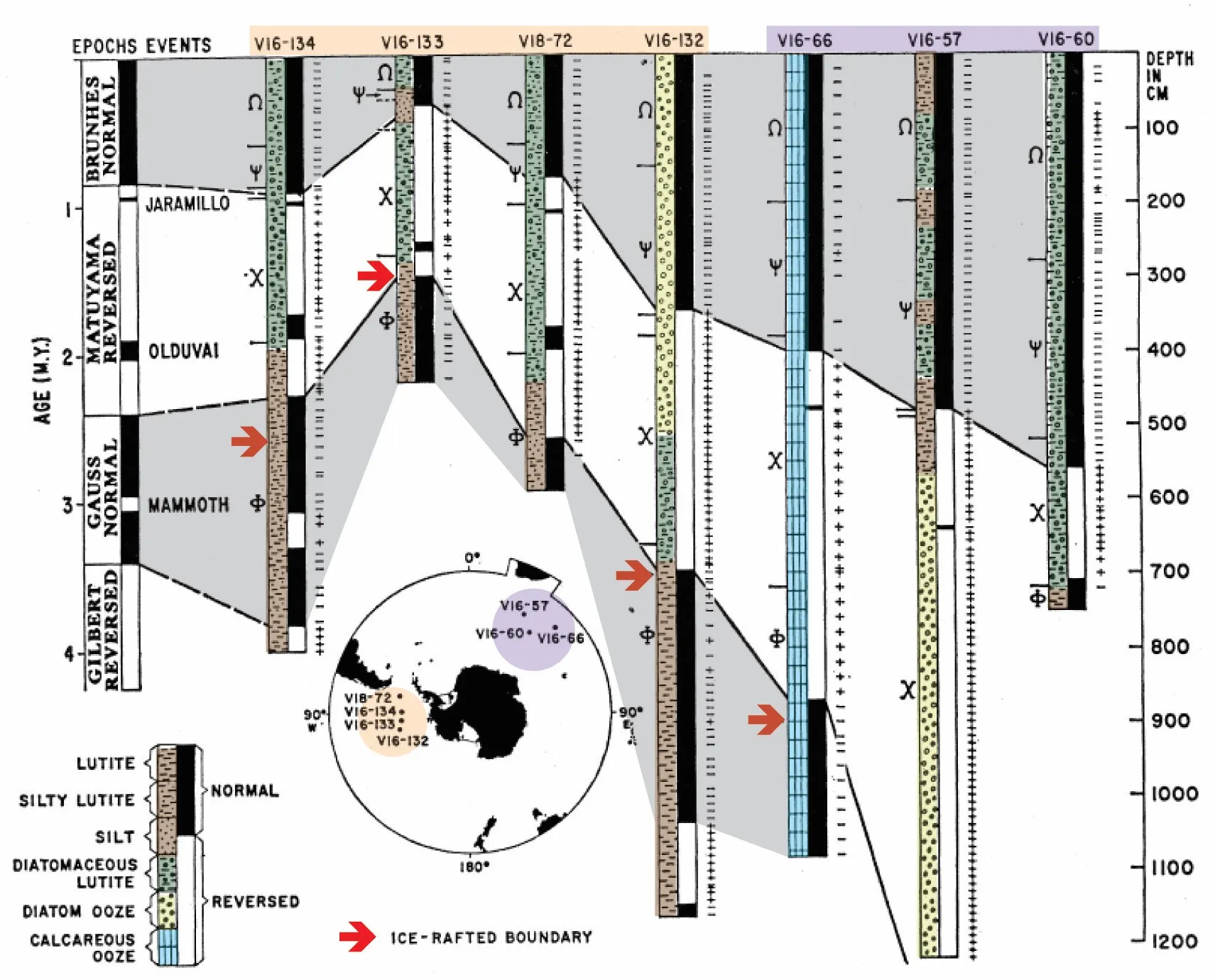
"Look at this, Fred," he said, "not only have we found the complete Cox, Doell, and Dalrymple timescale in these cores, but we have also discovered an additional, normal event around 0.9 million years. We have named it the Emperor event."
"Well, I am sorry to have to disappoint you," I said, "but the Menlo Park group have already resolved such an event, and named it the Jaramillo."
Needless to say, Neil was somewhat surprised to hear this. Brent Dalrymple had told me of the discovery of the Jaramillo event, when at the annual meeting of the Geological Society of America, in Kansas City, the previous November.
On the wall of the same room were pinned up the now famous Eltanin magnetic and bathymetric profiles across the Pacific-Antarctic Ridge, that Walter Pitman had recently reduced. By this time Walt had joined us.
"Furthermore," I said, "one can see it on these magnetic profiles, just as you can on the Juan de Fuca Ridge'.
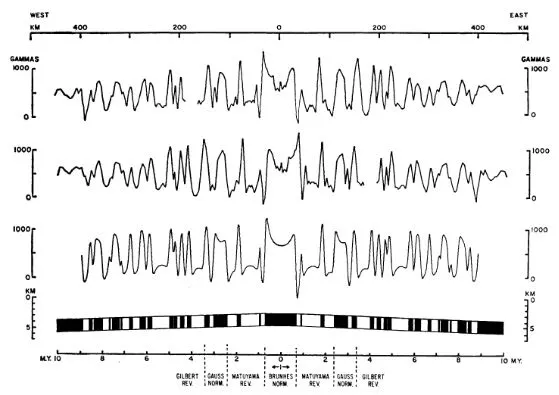
There was a momentary silence; it was Walt's turn to be surprised. Presumably Neil and Walt had already realized that the magnetic anomalies over the Pacific-Antarctic Ridge produced a new geomagnetic timescale, and implied an essentially constant rate spreading, but the news that I had realized this several months earlier in relation to the Juan de Fuca Ridge came as something of a shock to them. On this occasion I also remember meeting John Foster and Jim Heirtzler. Jim, either during my visit or soon afterwards, very generously let me have a copy of the Eltanin 19 profile, and details of the aeromagnetic survey of the Reykjanes Ridge, south of Iceland, which was the second extensive survey to demonstrate the symmetry of the magnetic anomalies about a ridge crest (that for the Juan de Fuca Ridge being the first). Presumably the Reykjanes ridge data was 'in press' at the time, for it appeared in print a few months later in Deep Sea Research.
Excerpt from: Lamont-Doherty Earth Observatory. Early Lamont, 2002. Niels Bohr Library & Archives, American Institute of Physics. One Physics Ellipse, College Park, MD 20740. https://repository.aip.org/islandora/object/nbla%3A6273.
A modern-day student of paleomagnetism would be astounded at the pimative operations that yielded the fantastic magnetic stratigraphies of deep-sea sediment cores by Neil Opdyke at Lamont, beginning in the mid-1960's. The one-inch sediment samples were rotated at low speed (to prevent them falling apart) in a spinner magnetometer, state-of-the-art for that era, built by a Lamont doctoral student, John Foster. The operator, Doris Lafferty, was imbued with incredible patience: it took 10-30 minutes to measure each individual sample, and there were dozens in each core. The results were written down by hand and duly carried up the hill to the Oceanography building where an elderly lady, whom I knew only as Grace, carefully typed the data into a machine that punched the appropriate holes on computed cards. Next morning, Neil's assistant, Peggy Larson, took the data and computer program, all on punched cards, to the seismology building where we had access to their IBM computer (I may be wrong after all these years but I believe it had only 128 kB memory!). A few minutes later, after digesting and processing the input data, the machine regurgitated a computer print-out with the results, which Neil obtained a full two days after his samples were measured. By contrast, a modern cryogenic magnetometer, such as the one now at Lamont, delivers the measurement of deep-sea magnetization in seconds. How technology has changed with time! What has not changed is the importance of these early results so laboriously obtained in the Lamont paleomagnetic lab.
In the 1960s Lamont's paleomagnetic laboratory was housed in the Core Lab, an unsuitable location for sensitive measurements. The service lift caused a disruption and some of the doors were steel lines, so that whenever they were opened or closed the magnetic background changed. In 1971 Neil Opdyke was able to persuade Lamont to provide better quarters. While searching for a magnetically quiet location, I was intercepted by a guard and hauled before the head of security to explain any suspicious activities! Lamont looked laid-back, but its security system functioned.
A small wooden building as soon built on a patch of ground around a disused well adjacent to the Core Lab, and we moved our paleomagnetic equipment into it at the earliest opportunity. Typical of the style favored by Lamont's inspired leader, Doc Ewing, our new lab had no frills. It did have heating in winter but it could become very warm on a sweltering summer day. It even had the occasional problem not encountered in our old quarters. One summer day I heard a near hysterical screech from our magnetometer operator, Doris Lafferty. A small copperhead, less than a foot long, had made its way across the open threshold into Doris' domain. It was probably hot and thirsty, and all hell having now broken loose, it was no doubt more scared than Doris. The creature was quickly removed to the nearby hedge and peace was restored. The incident was enough reason for a smoke break, a much savored occurrence in those distant unhealthy days! The later development of the lab to its present world-class configuration absorbed the original wooden structure and disused well. I have not heard of any subsequent reptilean visitors.
From: Lamont-Doherty Earth Observatory. Early Lamont, 2002. Niels Bohr Library & Archives, American Institute of Physics. One Physics Ellipse, College Park, MD 20740. https://repository.aip.org/islandora/object/nbla%3A6273.